August 27, 2009

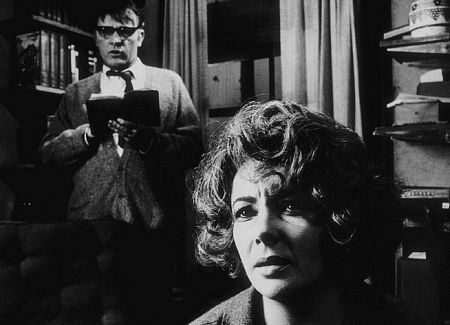
REVIEW: Who's Afraid of Virginia Woolf? (dir. Mike Nichols)


Cast: Elizabeth Taylor, Richard Burton, George Segal, Sandy Dennis

There are many things in this world that I find truly baffling. Why are we destroying our marine habitats so that rich Japanese couples can order expensive soup? Why do we demand that politicians solve all our problems for us, while secretly willing them to fail? Why do we keep expecting Guy Ritchie to make another good film? But perhaps the most baffling of all is the fact that Whose Afraid of Virginia Woolf? has never been released on DVD in Britain.

It is perhaps the finest filmic adaptation of a stage play ever rendered on celluloid. But only American audiences are able to enjoy it in the comfort of their own homes. Adaptations of plays can often be morbidly dull. They rely on the same visceral energy and tension that works so well in a theatre but is almost impossible to transfer onto a video recording that will be reproduced thousands of times and watched at the furthest possible remove (both emotionally and geographically) from where the actors actually performed.

The History Boys is ok, but it was a chirpy and simple play in the first place. Lindsey Anderson’s adaptation of David Storey’s play In Celebration was fairly successful at transferring the dramatic silence and tension of a play, but it was still fairly two-dimensional on a cinematic level.

Whose Afraid of Virgina Woolf? leaps over all of these pitfalls. Every time you watch it, it feels urgent and real. You feel like you are sitting in Martha and George’s house and you hope that Elizabeth Taylor won’t forget her lines as she is carried away in a spitting, passionate frenzy of emotion.

The story concerns a bitter, warring couple in the clutches of despair and alcoholism. Martha is the daughter of the College Dean, and her husband George is in the history department (although as Martha constantly reminds him he is not the history department) They live on the grounds of the college and escape from their dull lives by drinking and playing hurtful and heinous psychological ‘games’ with each other.

On this particular night a young couple, new to the college, arrive for a welcome drink. Nick is a fresh-faced, athletic biology professor and Honey is his mousey, chirpy wife. Over the course of the evening we see the relationships between these four people deteriorate. It may not sound very positive – and it isn’t – but it is wickedly funny at times and filled with the kind of conflict and tension that most filmmakers lie in bed dreaming about.

It is, however, a stage play in every regard: the entire story takes place in George and Martha’s house; the dialogue is dense and fast; and the tension relies on the viewer’s proximity to the awkward silences and spitting tirades of the actors. So why did this film succeed where so many theatrical adaptations have failed? I was about to describe it as ‘one of those inexplicable, synergistic moments in cinema’, but then I realised that this film absolutely does add up to the sum of it’s extraordinary and acclaimed creative parts.

To begin with, it was Ernest Lehman who decided to adapt Edward Albee’s successful stage play. This is the same Ernest Lehman who cut his teeth on the screenplays for North by Northwest, The Sound of Music, and The Sweet Smell of Success to name but a few; I think it is safe to say that the screenplay was in safe hands.

But who could possibly helm such a difficult production? Well Lehman and his Warner Brothers financiers finally settled on a young theatre director who, at the tender age of 32, had directed his first Broadway smash hit (Neil Simon’s Barefoot in the Park) which ran for 1530 performances. His name was Mike Nichols, and he would go on to direct a few fairly successful films like The Graduate, Working Girl, Primary Colours, and Charlie Wilson’s War.

Nichols may be a household name now; but in 1966 he was better known as a comedian and director of quirky Neil Simon plays. This comedic sensitivity certainly came in handy in this production, where the dark humour and poisonous wit espoused by the central characters needs a deft touch to prevent it being overlooked or, which is worse, overly obvious.

But this production really needed a serious talent behind the camera to aid the inexperienced Nichols. And who better than Haskell Wexler, the two-time Oscar winning cinematographer behind One Flew over the Cuckoo’s Nest and Bound for Glory. The camerawork in this film is perhaps the most important device for capturing the immediacy and energy of a play, and Wexler’s camera does this very well.

The cinematography is alive and perfectly attuned to the pace, tone, and emotional resonance of the characters and their story. Every time you feel that, had you been sitting in the stalls, you would be staring intently at George’s face – or gazing, overwhelmed, into the space between Nick and Martha – this is exactly what the camera does.

Wexler also worked on one of my favourite films of all time, John Cassavetes’ Faces. Cassavetes was a theatre man himself; and his films always relied heavily on the performances of his actors. Faces is one of his most stripped down films, and it is very theatrical in its unity of time and space (a pretentious was of saying that it happens in a limited number of locations over a limited timeframe). Wexler’s camerawork in that film is equally successful. He is at once obtrusive and subtle, sporadic and consistent, energetic and whimsical. You are never allowed to stop concentrating and yet you so rarely think to yourself “I am viewing this drama through the eyes of a man looking through a lens 44 years ago.”

But what are a director and his cinematographer without a cast to direct and film? This is one area of pre-production that was fraught with difficulty for Lehman and Warner Brothers. Every Hollywood star from Henry Fonda to Bette David wanted to be involved; but the density of the dialogue and the energy required from the starring duo left Nichols and Fonda doubting these weary and ageing Hollywood veterans.

Looking back, I’m sure no one can imagine anybody else playing George and Martha in this film. Richard Burton had had a mixed career, combining Hollywood epics with smaller independent films. But through the early 1960’s he starred in Tony Richardson’s Look Back In Anger (the first film that he was truly proud of) and John Huston’s The Night of the Iguana. I think that Whose Afraid of Virginia Woolf? was the triumphant pièce de résistance of a veritable legend of the cinema; and it came at a time when he had mastered the complexity of film and the raw emotional power of the theatre.

Elizabeth Taylor was considered by many to be the most beautiful woman in the world in the mid-1960s, and she was certainly one of the most powerful stars in Hollywood after her performance in Cleopatra and Cat on a Hot Tin Roof. But her performance in this film is measured, mature, and selfless.

It is now well known that Burton and Taylor’s marriage was on the rocks by the time they started filming, and their relationship finally broke down as a result of this film. Regardless of what was happening in their private lives, there is no doubt that these are two of the finest and most emotionally honest performances ever given in a Hollywood film. Burton is powerful but easily hurt, Taylor is a frumpish bully with a tender and weary heart. They both cackle and spit their way through a truly powerful, and pessimistic, story of a love that has been lost and is sorely missed.

I apologise if this has been more an extended biography of the cast and crew than a review of the film. But I think it is important to appreciate what Hollywood can do when it puts its mind to something. Warner Brothers assembled a perfect group of people: a young and passionate director, an experienced screenwriter and cinematographer, and a pair of well-known but underrated actors. And they created one of the most beautiful and heart-breaking films in cinema history.

Now I just wish they would share it with the rest of the world!

August 06, 2009

A Tribute to John Hughes


On 6th August 2009, one of the most important figures in the history of American cinema shuffled off this mortal coil while taking a quite walk in New York City. John Hughes may not have been a legend in everybody's eyes – and he certainly won’t be remembered as an amiable character or an especially renowned artist – but he most undoubtedly was an icon, and a creator of icons.

From his debut feature, Sixteen Candles (1984), Hughes enjoyed one of the most untainted runs of popularity and success ever achieved by a filmmaker. To this day Hollywood is reeling from its inability to ensnare this reclusive talent and study him more closely. His unique blend of innocent comedy and caustic realism was always shot through with an eternal hopefulness that may not have been an honest refection of Hughes’ own soul, but most certainly spoke to the young generations of Reagan’s America.

It is impossible to single out one of Hughes films for comment: Sixteen Candles, The Breakfast Club, Weird Science, Ferris Bueller’s Day Off, Planes, Trains, and Automobiles, She’s Having a Baby, and Uncle Buck were all released between 1984 and 1989. Hughes then took an epic hiatus of two years before releasing Curly Sue (1991), his final film as a director.

Who else could lay claim to such an uninterrupted string of successful films? Rob Reiner, the Coens, and Hitchcock are all close contenders (and for the last two probably better filmmakers) but none of them can hold a torch up to Hughes for targeting a generational epoch and owning it outright.

Oh, and just in case you have been checking dates and thought that 1990 was a slow year for John Hughes, he was busy producing a little-known film called Home Alone.

When you add to this roster the films that Hughes wrote but neglected to direct (Baby’s Day Out, Miracle on 34th Street, and Beethoven to name but a few) it is impossible to understand why anybody of my generation isn’t sobbing silently onto their keyboard.

Within this brief but extraordinary body of work lie some of the most iconic characters and movie lines in cinema history. Molly Ringwald became a teen legend after her ‘girl-next-door’ performances in Sixteen Candles and The Breakfast Club, and Matthew Broderick was launched into the limelight following his rambunctious turn as Ferris Bueller.

He had every major studio in Hollywood falling over themselves to co-produce any projects that Hughes Entertainment was considering. Warner Bros turned down Home Alone and allowed Twentieth Century Fox to pick up one of the most successful kids films in history, and from then on it was a constant struggle to get hold of Hughes at his agrarian retreat outside his beloved Chicago.

Hughes may not have been the most friendly or sociable of men; and I see no reason why death should act as a moral antiseptic. He switched agents almost as often as underwear, and was the scourge of low-level film set workers due to his reputation for firing innocent people on a whim. He was infamously reclusive and avoided all contact with the press, and rarely went anywhere near Los Angeles unless it was absolutely necessary. These last two character traits are often cited as proof of Hughes unpleasant manner, but I see know reason why a filmmaker should have a responsibility to cavort around Sunset Blvd. and humour the careless journalists that followed him around. He did all his talking on the screen, and he was good enough to make Hollywood come to him!

His films may not have had anything really important to say, but they still spoke to the everyday children of 1980s America who felt that they were unimportant in the eyes of their parents, schools, and governments. These films should be stored away in the Library of Congress as a perfect representation of the mood and tone of 1980s middle America. They were a generation that had no emo, no Nirvana, no Grateful Dead, just a quite, bespectacled man from Michigan.

July 31, 2009

Hooray for the BFI Southbank!


I had dinner with Neve Campbell the other night. I say ‘dinner’ but it was actually about 1am and we were sat in an almost empty bar at the Park Lane Hilton nursing sore feet from a day at Cartier. This isn’t my normal scene, by the way, but I was invited by a mutual friend and the alcohol was free. It was actually my lack of funds that instigated my conversation with Neve, as she kindly offered me some hummus and a slice of her club sandwich. So anyway, over our hummus and jaw-shatteringly generous portion of turkey and bacon it transpired that Neve lives in London. As an experienced and talented actress living in London, I thought she might be interested in a discussion of the pros and cons of the BFI (fascinating, aren’t I?) Her reply will ripple through the membrane between my ears and skull for a long, long time… “the B-what?”

It was at this moment that I realised something: the lives of every film fan in this city don’t necessarily revolve around that auspicious and hallowed archway beneath Waterloo Bridge. I’m sitting with a globally renowned leading lady who has worked with the likes of Richard Attenborough and Simon Beaufoy, and she doesn’t even know that our national cinema exists!

I suddenly realised that even some of you, my esteemed readers, might not have graced the hallways of that dank, claustrophobic building and felt the weight of cinema history hang down upon your shoulders like a thick down blanket. I have therefore taken it upon myself to explain exactly why everybody in London who likes films needs to spend more time at the BFI.

Firstly, on an historic note, many of you may have visited the site without remembering it. It once housed the Museum of the Moving Image, a world-renowned museum that provided wonder to generations of young film lovers in the 90s. The area taken up by the museum now houses a swanky Benugo bar and a bookshop on all things ‘cinema’. I spent a lot of my childhood at that museum, and the building still holds an air of fantasy and that ethereal magic of the cinema. In a world where the romance and tradition of the cinema has been doused by the behemoth of Multiplexes and vats of Coca Cola, it is so important to have a purely cinematic space like the BFI Southbank where one can soak up the history and magnanimity of the moving image.

On another historical note, this is where the Free Cinema ‘movement’ enjoyed its brief but spectacular residency. In 1956, Lindsay Anderson – along with Karel Reisz, Tony Richardson, and a host of enigmatic young British filmmakers – decided to show a series of films that shared a common spirit: the idea that,

“No film can be too personal.
The image speaks. Sound amplifies and comments.
Size is irrelevant. Perfection is not an aim.
An attitude means a style. A style means an attitude.”

It was considered the first attempt at a genuine National cinema in Britain: the moment we tried to shatter the chains that bound us to Hollywood. The arrival of Channel 4 and the subsequent rise of Frears, Loach, Leigh, et al provided us with a more renowned and identifiable national aesthetic; but this era of British cinema, when Hollywood were desperately waiting to see what Richardson would do after Look Back in Anger, was so important… and it all began under Waterloo Bridge.

On a more practical note, the tickets are much, much cheaper than your local multiplex. There are also no confectionary stands or fizzy drinks, which has the double advantage of saving money and allowing you to watch the whole film without suffering a herd of imbeciles thoughtlessly grazing on monosodium glutamate all around you.

The range of films means that there is something for everybody: For example, Film Fundays, held on one Sunday every month, is a double-bill showing one children’s film and then one family friendly film (usually an old classic for the parents.) It is a great opportunity to spend a day at the pictures, followed (or preceded) by a leisurely walk along the Southbank to give the kids some exercise and fresh air.

At every screening you are provided with a ‘one-sheet’ which usually contains the Sight & Sound review for the film you are watching, followed by an interview with the film’s director. The sheet also provides you with all the production details and a list of similar events and screenings in the coming weeks. It really is a wonderful experience for a film lover; it reminds you that loving films is an artistic passion that should be cherished and nurtured, not a mindless hobby that should be exploited by popcorn vendors.

The final reason, and perhaps my ulterior motive for writing this piece, is that we film lovers are under threat at the BFI Southbank. The extension of the cinema into the old museum a few years ago may have provided us with space for a wonderful bookshop, multimedia gallery, and workspace; but it also provided ample space for a kitsch and overly fashionable bar. Was it Roosevelt that said, “Build it and they will come”? Either way, this is exactly what has happened, and the cinema is now crammed full of ‘hipsters’ and ‘media-types’ in colourful clothes, thick-rimmed glasses, and side partings.

The recent renovation of the riverside bar has amplified the problem by providing a breeding ground for these media darlings. They now occupy both ends of the building and they are closing in fast. Now, if you want to reach the actual screening rooms, you have to force your way through crowds of these mojito-sipping, Skins-loving heretics. We need your help!

Firstly I suggest destroying the Benugo enterprise by showing up in great numbers and spending so long ordering glasses of tap water and complimentary olives that nobody has time to serve our nemeses (who could easily head over to the OXO tower or some other neutral territory). We would then be free to bask in the loneliness of our weird, wonderful, and poverty-inducing love of the cinema.

If you do decide to go on the basis of my recommendation, then please mention my name somewhere, maybe I’ll get some free tickets!

July 17, 2009

REVIEW: Frozen River (dir. Courtney Hunt)


Cast: Melissa Leo, Misty Upham, Charlie McDermott, Michael O'Keefe

Yesterday evening I had an unpleasant realisation… I had completely forgotten to watch Courtney Hunt’s much lauded debut feature, Frozen River. This was, of course, unacceptable. The last ‘promising’ female screenwriter to demand the attention of the Oscars was Diablo Cody, but on the assumption that the Oscar’s couldn’t be so disastrously wrong two years in a row, I decided to head over to the Odeon Panton Street to watch Frozen River.

At University I was forced to consider the importance of the ‘performance space’ to the experience of seeing a play or film. There is no doubt that the chosen location for a film’s exhibition – be it a living room, the local Multiplex, a rundown family theatre, or an archway near London Bridge – makes for a unique viewing experience. I had never actually entered the Odeon Panton Street (the one hidden behind the Odeon West End next door to the Odeon Leicester Square… monopoly anyone?) but I had always found it unassuming and, by extension, strangely alluring.

Now that I have seen a film there, I can promise you that it is the most disappointing cinema in London. I am still gob-smacked that they are allowed to charge the same £10 entry fee as the Odeon Leicester Square (a juggernaut of a screen) for the pleasure of sitting in the most cramped screening room in London, with a screen smaller than most home cinemas. At one point a person stood up three rows in front of me and blocked the entire screen. Screen 3 is literally a converted attic space. If you are ever choosing where to watch a film… avoid the Odeon Panton Street at all costs!

Fortunately, these unacceptable surroundings did not take away from what is, in my humble opinion, one of the finest films of the year. I simply cannot comprehend why this film didn’t do well at the Oscars. Oh wait… I just remembered the embarrassing bout of Slumdog fever that plagued this year’s festivities.

After the curtains had opened (it didn't take long... the screen was barely wider than my arm-span! Ok, I will douse my bitterness) the film began with a series of beautiful shots of upstate New York. This is the only time in the entire film that you are ever really aware of the cinematography. But it is always there: effortlessly matching the tone of the film and providing an extra layer of gritty realism. At certain points you can almost feel the icy cold and barren loneliness of the border country.

The camera soon finds its way to Ray Eddy (Melissa Leo) on the morning that her new ‘doublewide’ mobile home is arriving. Her youngest son, Ricky, is giddy with excitement at the prospect but his older brother, T.J. (a fifteen year old who has had to grow up far too fast), seems far more subdued. The reason for T.J. and Ray’s anxiety is that the patriarch of the family, a hopeless gambling addict, has fled to Atlantic City with the money that was supposed to pay for the house

Sure enough, the deliveryman refuses to hand over the house and explains that Ray needs to find the $4500 by Christmas or she will lose her $1500 deposit. Shortly thereafter, while searching for her husband at a casino on the local Indian reservation, Ray has an unfortunate run-in with Lila Littlewolf (Misty Upham), a rude young Indian woman who seems to have stolen Ray’s husband’s car. Lila forces Ray to drive across the St Lawrence River to smuggle illegal immigrants into the U.S. from the Canadian side of the border.
This is the set-up, and I will take you no further into the story because I see this as a blog for recommending, rather than ruining, good films. What I will do is try to explain why this story is so wonderfully hard-hitting, honest, and entertaining all at the same time.

To begin with, there is not a single element of the story that feels forced or dishonest; everything happens because of something deeply embedded in the characters emotional or social make-up. This is a very difficult thing to do, and it would have been impossible if the central characters hadn’t been so fully realised.

They are simple people with simple needs: Ray needs her new house to feel good about herself and please her children; Lila needs to make money to get her baby back from her mother (who stole the child from the hospital); and T.J. needs to feel like a man so that he can break out of his childish respect for his rat-fink father and start looking after his beloved brother.
But these simple needs betray a depth of character that is incredibly individual but also symptomatic of the society that they are forced to live in. Their needs are, for the most part, actually desires, and quite selfish ones at that. Their desperate attempts to fulfil these desires are driven by a misplaced belief that they are trying to please those who are close to them… but most of the time they end up hurting each other instead.

The basis is simple and effective: people in need of money are allowed to blur the lines of morality in the desperate pursuit of selfless and just goals. Or, to give it a Machiavellian twist, “the end justifies the means”. But the story investigates this most simple and engaging of ‘thriller’ conceits to its dramatic and socially affective end.
Can we really forgive Ray for aiding the despicable trade of human beings just because she wants a new house? Throughout the film her actions have unintended destructive consequences (increasing in dramatic effect as she gets dragged deeper into the world of trafficking) that we can’t help but blame her for, even though she is our protagonist and we generally support her decisions.

This constant, dizzying confusion that surrounds the morality of our protagonist’s actions is one of the truly hard-hitting elements of the film. As soon as we throw ourselves into a predictable ‘film audience’ empathy for the hero, we are slapped round the face as she pulls out a gun or forces the transformed Lila to take part in ‘one last job’. We want to support her, and we do because we know we would probably do the same thing, but we are forced to feel guilty for that natural sense of empathy for the underdog hero.

There is no doubt that the film is honest and hard-hitting in the extreme; but it is also genuinely entertaining on a dramatic and visceral level. It is the story of a gun-wielding ‘mom-turned-smuggler’ who drives across a frozen river to smuggle immigrants for Mafia bosses for Christ’s sake… what more do you want!

I wont tell you anything about the ending because I don’t want to ruin the film… but I so desperately want to tell you how well conceived it is. It follows on perfectly from the honest but entertaining nature of the rest of story (no mean feat, as endings to films like this are notoriously difficult to navigate).

This film really does have everything. If you fancy a trip to the cinema and were going to watch Harry Potter because it was the first film that came to mind, then please reconsider and watch this instead! If you are disappointed then you can ignore me – and the good people of the Sundance Film Festival Jury – for the rest of your lives. But if you enjoy it… well don’t say I didn’t tell you so!

July 14, 2009

REVIEW: Harry Potter and the Half-Blood Prince (dir. David Yates)


Cast: Daniel Radcliffe, Emma Watson, Rupert Grint, Michael Gambon, Jim Broadbent, etc

I believe the definition of synergy is something along the lines of, ‘the interaction of two or more agents to produce a combined effect that is greater than the sum of their individual effects’. In which case the only positive-sounding word I can use to describe this film is… well, ‘synergistic’. I suppose it is rather like one of the miraculous potions brewed up by Professor Slughorn at Hogwarts: a drop of this, a rat’s tail, and the juices of a crushed beetle can produce a wondrous concoction.

This film takes the narrative of a half-hour episode of Beverly Hills 90210 (teeny heartbreak, the ‘bad kid’, the ‘cool kid’, sports, etc.), drops in an odd story about a magic cupboard, allows it to simmer for a while… and voila! A two and a half hour epic that does absolutely nothing except stupefy!

I have to confess to not having watched the fourth of fifth films in the Potter franchise (or should I be confessing to actually having watched the first three?) and as I sat down in the cinema I did actually have a momentary pang of dread that I wasn’t going to understand the plot! Firm slap on the hand for me for thinking that this franchise had managed to offer up a shred of valid intrigue or suspense over the past three years.

I appreciate that this is the ‘build-up’ film for the final, two-part climax, ‘The Deathly Hollows’; but surely something dramatic or interesting should happen over such an inexcusable time span? This is becoming something of a habit for studio blockbusters: Transformers 2 came in at about 150 minutes as well, and James Cameron’s Avatar is looking set to do the same. Why?! Ingmar Bergman gave us ‘The Seventh Seal’ in 97 minutes!

The film sees Potter returning to Hogwarts for his penultimate year of study. Once again he has in the inside scoop on the latest addition to the faculty; and once again Dumbledore needs his help in staving off the forces of evil from the gates of the school. Thrown into the mix are a few parties, some drunkenness, some tears, and some Quidditch. There are a few things that I still don’t understand about this whole sorry debacle: why do the forces of evil want so badly to get into a school? And why is the fact that Harry’s parents sacrificed their lives for him supposed to make him special? If I met somebody who jumped out of the way when their own child was in danger I would spit on them.

But the thing that I really don’t understand is the pride with which the film’s makers declare, “this is the film where the children really grow up”. They are correct, of course. The children have ‘grown up’ from 16yrs to 17yrs; and now there is snogging, beer-drinking, hanging out on stairwells, and everything else 17-year-olds do that 16-year-olds would never dream of.

But why is that an attractive publicity ploy? I appreciate that every male above the age of 18 is longing for the day when they can announce their lustful desire for Emma Watson without getting entered onto the public offender’s register; but apart from that who cares whether they are 15 or 18? They still can’t act, they will never be adults, and they exist in an imaginary realm where a global battle between good and evil is being waged. Did you ever here Peter Jackson announcing with glee that this was the film where Frodo and Sam really grow up? Nonsense!

Of the absolutely inexplicable two and a half hours, I would estimate that approximately half an hour of the film is taken up with the attempt to save the world and defeat Voldemort (we’re allowed to say his name now by the way); the other two hours is taken up with the bittersweet romances of our overwhelmingly mature and awe-inspiringly adult-like starring trio.

Imagine ‘Star Wars’ if Darth Vader had ten minutes of screen time, the Death Star was never even glimpsed, and the entire film was played out onboard the Millennium Falcon where Luke and Hans whine and argue about their love for Leia… disappointed by the prospect? You should be.

As you might have guessed, I didn’t really like this film. But what did you expect? I am a staunch supporter of narrative integrity and emotional character arcs; and these are not important in a multi-billion dollar franchise adaptation of a children’s book (I know they say it is for adults too… but adults usually use that argument with a distinct lack of conviction and a melancholy glimmer of shame in their eyes.)

It is evident that the filmmakers have made no effort to appeal to anyone outside the early-teen age bracket with this film. The only evidence of any emotional involvement from my fellow audience members was a squeal from the 12-year-old girl behind me when Harry and Ginny finally kissed. The thing that reaches out to a wider audience and justifies the eye-watering budget is the ‘look’ of the film; and there is no denying the fact that this film actually ‘looks’ quite good.

The CGI is mostly impressive, but you can’t help but worry about its longevity. At times like this I always remember the first time I saw ‘Air Force One’ and thought the CGI ‘plane-crashing-into-the-ocean’ scene was mind-boggling: now it is laughable.

The thing that really stands out about this film is not the CGI but just the general aesthetics of it: the darkness; the quality of the imagery; the scenic backgrounds; the fact that Hogwarts manages to look inviting in its grandeur and yet terrifying in its cold detachment at the same time. Bruno Delbonnel was the cinematographer on this picture, and I hope that David Heyman and Warner Bros are thanking him in their dreams for creating a visually stunning and alluring film to distract any discerning viewers from the dull and uninspiring plot.

In short… oh hell, go and watch it! It’s quite fun. Daniel Radcliffe is still so bad its funny. And Emma Watson is lovely.

June 26, 2009

REVIEW: Rudo y Cursi (dir. Carlos Cuarón)


Cast: Gael García Bernal, Diego Luna, Guillermo Francella, Jessica Mas

Tonight I was invited by The Script Factory to attend a special screening of ‘Rudo y Cursi’, followed by a Q&A with the film’s makers. ‘Rudo y Cursi’ is the directoral debut of ‘Y tu mamá también’ scribe Carlos Cuaron. It is also the first first film to be unveiled by the new Mexican production powerhouse, Cha Cha Cha Films.

It’s a new company but the names of the three founders might ring some bells somewhere in the deep recesses of your mind: Guillermo del Toro, Alfonso Cuarón, and Alejandro González Iñárittu! The film also happens to star the two most iconic faces of the Mexican New Wave, Gael García Bernal and Diego Luna.

There is no equivalent to this film anywhere in the canons of cinema. It is the Mexican equivalent of Coppolla, Peckinpah, and Scorcese teaming up to produce the directorial debut of Robert Towne, starring De Niro and Nicholson. Or Christopher Nolan, Gus Van Sant and David O. Russel teaming up to produce… well you get the picture.

So what sort of film has the triptych of Mexican cinema chosen as a calling card for their new company? Is it a searing urban drama with a fractured narrative? A CGI epic with a historical twist? A buddy/ road movie with a dark heart? Or a Dickens adaptation? (hands up those who forgot Alfonso Cuaron’s modern retelling of Great Expectations!)

The answer is a merger between a few of these things, but with a result that bears no resemblance to any of them. This is a film that is surprisingly rudo (rough) but also unashamedly cursi (corny); and within this mutually beneficial dialectic can be found the unique, inexplicable beauty of Mexican cinema in its modern guise.

It is a film that shares the sweaty, energetic aesthetic of ‘Amores Perros’ and ‘Y tu mamá también’; but it also has a humour and free-flowing ease that allows it to float away from the filmography of it’s creators and waft across the screen in waves of laughter.

Carlos Cuaron conceived the idea of a football mockumentary, and announced it to Bernal and Luna, during a publicity tour for ‘Y tu mamá también’; but when both actors expressed a desire to play the part of the footballing buffoon destined for fame and humiliation, Cuaron was forced to write in a brother (which character is the brother is a point of endless contention between the jibing stars who are lifelong friends).

The result is a story in which to awkwardly-placed brothers are forced to jostle with each other for the attention of their football scout, their mother, and the affection of the nation. Beto (Luna) is nicknamed Rudo because of his ruthless style of goalkeeping; Tato (Bernal) is given his nickname Cursi because of his shamelessly cheesy attempts at achieving pop star fame with a rendition of Cheap Trick’s ‘I want you to want me”.

The film follows the brothers from their humble banana plantation to the ‘monster’ of Mexico City. As they both achieve fame for their football talent, they both fall into the traditional trappings of excess: egotism, socialite girlfriends, spending sprees, and gambling addictions. The film leads towards the traditional ‘big game’, but not in a way that you would expect of a normal sports film.

In fact, nothing in this film fits within the genre of ‘sports film’, or any other genre for that matter. It is the rags to riches, and then back to rags, story of two football players and yet there are approximately ten seconds of football footage in the entire film. It is a film about so many of Mexico’s social ills (corruption, the drug trade, the irresponsible treatment of young sportsmen) and yet it only glances at these problems with the inquisitive eye of a satirist. It is a modern comedy and yet it owes so much of its visual and situational humour to Hollywood’s Screwball years.

Del Toro called the film a “sheep in wolves clothing”, and that has proved to be the case. Just listening to the Cuaron brothers and the two stars talking on stage, it was so clear that they had an enormous amount of fun making this film. And yet the film has had just as enormous an effect on Mexican society as any of their previous films that were made with social criticism much closer to the forefront of their minds. Politicians in Mexico have been using Tato’s embarrassing Pop song in campaigns (some to gain support, others to humiliate rivals) and the very phrase ‘rudo y cursi’ has entered the Mexican lexicon (I have always wanted to combine those words) and spread far beyond the world of film.

The modest and quietly spoken Alfonso Cuaron was humble in his assessment of the way Mexican cinema has changed since his arrival on the world stage. He pointed out the irrelevance of a ‘film’ industry in a country that desperately needs to support so many other industries that are truly necessary. But where he seemed truly optimistic and burning with pride was when he spoke of the space that Mexican cinema has demanded for itself on the crowded and unfairly distributed ‘world cinema’stage. Cuaron and his band of brothers have taken the world by storm before; I have no doubt that they will do it again, and eventually go down as one of the most important and determined movements in film history.

Backyard Theatres: A death knell for multiplexes

I rarely go to the cinema now unless it is under duress. I attend the BFI Southbank fairly regularly because my knowledge of film history is not comprehensive enough to bully other film critics into submission… yet. But even this bastion of cineastes has been penetrated by the Benugo-bar media hipsters who burst out of Soho and Clerkenwell on sunny evenings and descend on our humble National Film theatre. The cowering remnants of European film lovers are therefore forced to pick their way carefully through a heaving mass of colourful shirts, leather satchels, and thick-rimmed glasses to reach NFT2 (which now shares an entrance with the men’s toilets).

The Curzon cinemas and Picturehouses of London are bearable in the afternoon, when most people are still at work, but the likes of Cineworld and Odeon cinemas are the filmic equivalent of a night out at Yates’ Bar and I really don’t understand how anybody can enjoy themselves there. You pay around £11 for a ticket, and the extortion not only continues but is actually elevated to eye-watering levels when you get into the foyer and try to buy a bag of M&Ms and a paper tankard of some bright-orange sticky fluid for about £9.

People often refer to the advances in ‘Home Cinema’ as providing the foundations for a revolution in cinematic exhibition. And it is certainly true that DVD sales and other subsidiary markets have eclipsed theatrical revenue to such an extent that a film’s theatrical release is now seen as part of the marketing campaign for the release of the DVD. But all these Blu-Ray players, surround-sound systems, and giant Plasma screens are not fulfilling their potential because 90% of us are cramming them into living rooms and damaging our eyes and ears.

The real revolution is underway, however, and it is time to get involved. The movement in Backyard Theaters (I’m spelling it their way because they started it) has swept across the US – just visit www.backyardtheater.com if you don’t believe me – and I feel certain that the trend will continue in Europe. Whether you drag your dad’s old projector out of the attic and point it at the side of your house, or invest your children’s college fund in a state-of-the-art HD projector, popcorn machines, and a giant tarp screen that eclipses your house and leaves your neighbour in a permanent shadow; this is the summer for turning your garden into a private cinema.

Invite your friends and family round, have a barbeque, and settle down to watch a film of your choice (although I would suggest starting with some old Drive-In classics just to set the mood… maybe Gun Crazy or It Happened One Night) in the comfort of your own garden. The advantages of choosing your own films, making your own food and drinks, and inviting your own audience, must surely outweigh the initial investment of a cheap projector and some white paint!